


With today's increasingly distributed teams and remote work, product management includes managing external teams, vendors, consultants, development agencies, and contractors. Having such diverse groups work together requires conscious strategies that ensure alignment, quality, and timeliness in support of the product's goals.
The following are some effective collaboration techniques, communication best practices, and project management tips that can help a product manager lead external teams to success:
Why manage external teams?
Outsourcing teams offer a degree of flexibility, specialist expertise, and scalability that many internal teams lack. Development is boosted and fills critical skill gaps while reducing overhead, most especially for startups and fast-scaling companies.
Key Principles of Product Managers working with External Teams:
Define the project's vision, scope, deliverables, and timelines, and describe its external teams. Being clear from this stage averts misunderstandings and forms a foundation for trust and accountability.

Clearly define roles and responsibilities:
Align the quality standards, technical requirements, and acceptance criteria. Also agree on the communication channels, meeting cadence, and escalation processes.
In-depth partner due diligence:
Evaluate the skills, experience, cultural fit, and references of the potential external teams. Select partners whose capabilities and workflows best match your project needs and company values. Set up regular check-ins, status updates, and an open forum for blockers/questions. Leverage collaboration tools like Slack, Jira, and video conferencing to bridge the gaps.
Encourage two-way feedback:
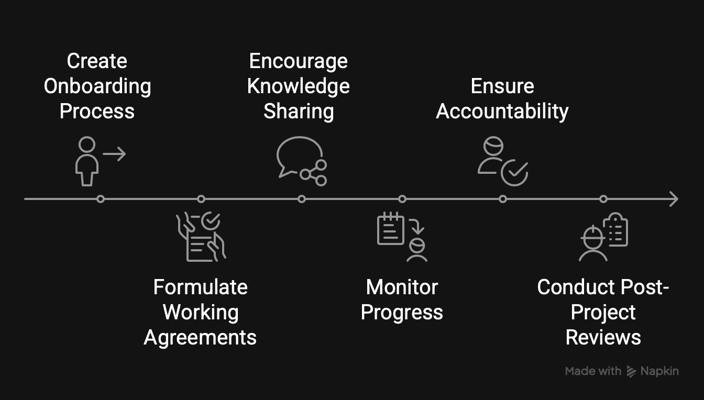
- Create a robust onboarding process.
- Formulate detailed working agreements.
- Encourage knowledge sharing and collaboration.
They should be, in practice, considered an extension of your internal team-you have joint problem-solving sessions, retrospectives, and planning that includes them. - Monitor progress; be flexible.
Track milestones, bugs, and deliverables through project management software. Be prepared for scope changes or inevitable issues; make adjustments through iterative replanning and reprioritization. - Accountability and recognition play a crucial role in building trust.
Recognize good work and hold each party responsible for their commitments. When teams deliver on agreed-upon expectations through open communication, the level of trust increases; long-term partnerships can be established in this manner. - Conduct Post-Project Reviews.
When complete, review successes and areas of improvement with the external team. Document lessons learned for future collaboration to provide a better relationship.
Practical tools and technologies that support collaboration and communication:
- Documentation:
Confluence, Google Drive, Notion
- Version Control:
GitHub, GitLab, Bitbucket
- Time zone coordination:
World Time Buddy, Google Calendar
Final Thoughts
The effective management of external teams requires striking a balance among good communication, mutual respect, and organization. Product managers with such attributes go on to extend their capabilities by driving faster product delivery and valued partnerships. With the right mindset and tools, the external teams can be potent allies in delivering outstanding products that both delight users and meet business goals.

 Elizaveta Sokolova
.webp?width=624&height=427&name=startup%20(1).webp)

 Juliya Moshkareva