


In today's competitive digital marketplace, user experience has emerged as a key differentiator. While DevOps was initially focused on the faster delivery of software and improved infrastructure, its role is now evolving in the context of UX. Integrating UX principles at every step of the DevOps lifecycle ensures speed of delivery goes hand-in-hand with quality, usability, and customer satisfaction.
The Increasingly Important Role of UX in DevOps
Today's users will tolerate nothing less than seamless, intuitive, and responsive products. Poor experiences lead to user churn and damage the overall brand reputation. Traditionally, DevOps focused on increasing deployment frequency, reducing time to market, and operational stability-usually at the cost of UX concerns.
DevOps' responsibility is increasingly to ensure faster releases don't come at the expense of customer satisfaction, which encompasses activities such as user feedback and usability testing, all the way through performance monitoring in the pipeline.
Key Benefits of UX-Driven DevOps
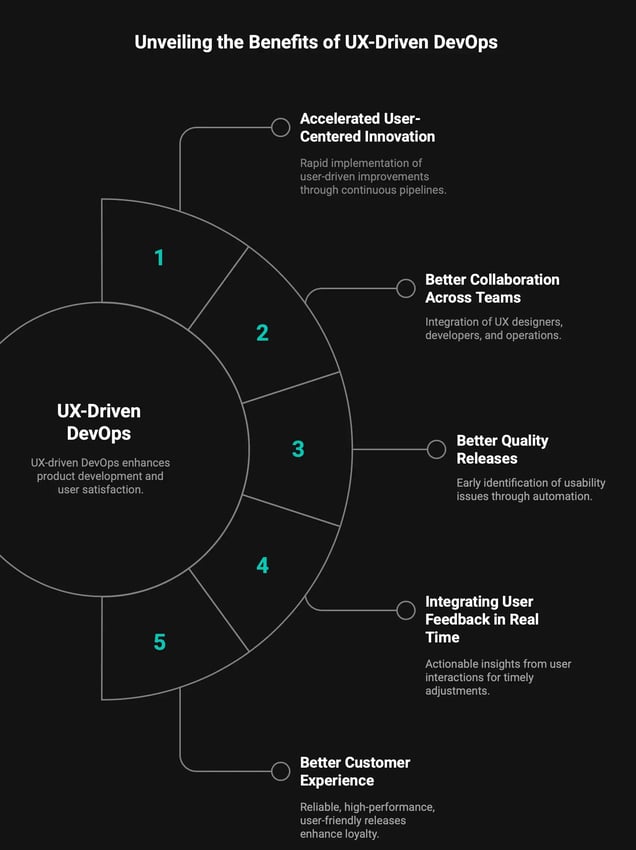
- Accelerated User-Centered Innovation:
These teams are empowered to implement user-driven improvements through continuous integration and deployment pipelines rapidly. - Better collaboration across teams:
It integrates UX designers, developers, and operations toward shared objectives, negating silos and enhancing overall product coherence. - Better Quality Releases:
Automation of testing and UX validation can help identify usability issues much earlier, rather than later, and reduce costly post-release fixes. - Integrating User Feedback in Real Time:
Observability and monitoring tools provide actionable insights to help determine how users interact with the product, allowing for timely adjustments. - Better Customer Experience:
Continuous releases that are reliable, high-performance, and user-friendly create loyalty and satisfaction.
Challenges in Integrating UX into DevOps
- Cultural and Process Differences:
UX typically involves iterative design cycles and qualitative research, which contrasts strongly with the fast-moving, automated approach of DevOps. - Timeline Alignment:
UX research and testing should fit into rapid sprint cycles without becoming bottlenecks. - Tooling Complexity:
Coordinating design tools, development environments, and monitoring platforms at scale is highly technically and organizationally challenging.
- Balancing Speed and UX Depth:
Sometimes, superficial UX testing is done at the cost of feature delivery speed.
Best Practices for UX-Enabled DevOps Success
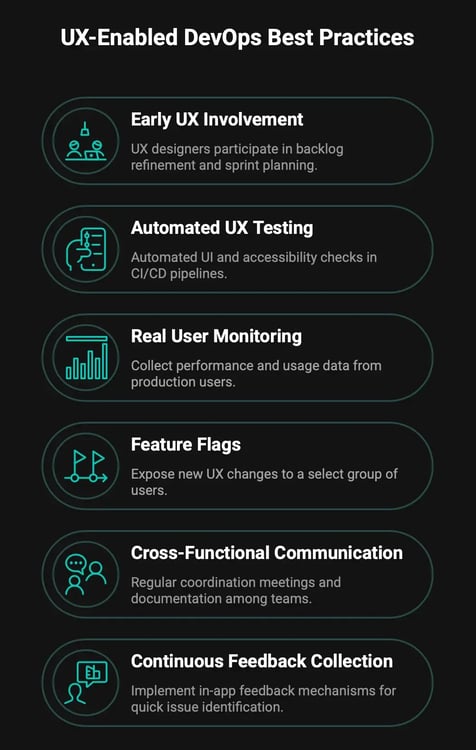
- Involve UX early:
UX designers should participate in backlog refinement and sprint planning to embed the user's needs right from the beginning. - Automated UX Testing:
Add automated UI and accessibility checks to the CI/CD pipelines that will repeatedly verify the quality of the user interface. - RUM:
Collect performance and usage data straight from production, from real users, in order to find points of friction for the experience. - Feature Flags:
Expose new UX changes only to a select group of users to enable controlled experiments and rollbacks. - Encourage Cross-Functional Communication:
Establish regular coordination meetings and documentation among UX, development, operations, and product teams. - Feedback is continuously collected:
Implement in-app feedback mechanisms to ensure that issues are identified quickly for users and inform development priorities.
The Role of Emerging Technologies
AI and machine learning will play a crucial role in integrating UX and DevOps. An example relates to AI analytics, which could help give forecasts regarding user behavior and application bottlenecks, while intelligent automation simplifies testing and deployment. AI also underpins personalized delivery of UX, where features are dynamically tailored to specific groups of users.
Metrics and Measurement: Ensuring UX Quality
Track KPIs such as:
- User satisfaction scores: CSAT, NPS
- Application load times and responsiveness
- Error and bug rates regarding UI
- Feature adoption and usage analytics
- Speed of feedback loop - time from feedback to fix
Continuous tracking of such metrics in DevOps dashboards will keep UX just as relevant as technical performance.
The Future of UX and DevOps
With cloud-native architectures going mainstream, along with microservices and edge computing, providing a consistent user experience across systems will remain increasingly complicated yet necessary. DevOps will embed UX maturity models within its frameworks and emphasize user-centric metrics alongside design thinking across all development stages.
Conclusion
User experience and DevOps are no longer different worlds. Merged, they will achieve a strong synergy, delivering a product that feels just right to users more quickly. Organizations that integrate UX into their DevOps practices will have the winning ticket to a competitive advantage through customer satisfaction by providing non-intrusive, intuitive digital experiences in 2025 and beyond.

 Hleb Skuratau
.webp?width=624&height=427&name=DevOps%20-%20Summing%20up%20the%20results%20(1).webp)
 Elizaveta Sokolova
