In many cases, the process of cost optimization in the cloud begins identically: the team logs into the billing console, eliminates unused instances, deletes unnecessary resources, scales VMs down, and so on. After a few weeks, the cloud bill is reduced, and the issue seems to be resolved. But 2-3 months later, the same issue comes back. New environments appear without clear owners. Resources become overprovisioned again. Temporary services keep running after projects are completed. Cloud spend starts growing faster than the business can explain. This is what happens when companies treat cloud cost optimization as a one-time technical task. The issue is not optimization itself. The issue is that one-time optimization removes symptoms without changing the system.
Cost Optimization Solves the Immediate Problem
Cost reduction, traditional practice focuses on one simple question: what do we cut down today? The practice is effective. It allows us to immediately identify the obvious inefficiencies: underutilized resources, oversized infrastructure, unused storage volumes, obsolete testing environments, ineffective Kubernetes nodes, and services with undefined ownership. However, this way often turns out to be just a cleanup exercise. The spending is reduced, the outcome is documented, and the team continues its routine development cycle. While the underlying process stays untouched. As long as the engineers can continue provisioning the infrastructure without the spending restrictions, the CI/CD pipeline ignores the impact on spending, the tagging and ownership practices are optional, and the finance team keeps the only visibility into the cloud spending, the spending will keep growing. The cloud bills do not increase due to one bad decision. They do so when cost management is not an integral part of the operational model.
FinOps Turns Optimization Into a Continuous Process
FinOps solves a different problem. It is not a one-time cleanup, and it is not only a financial responsibility. It is an operating model that connects engineering, finance, and business teams around a shared understanding of cloud cost.
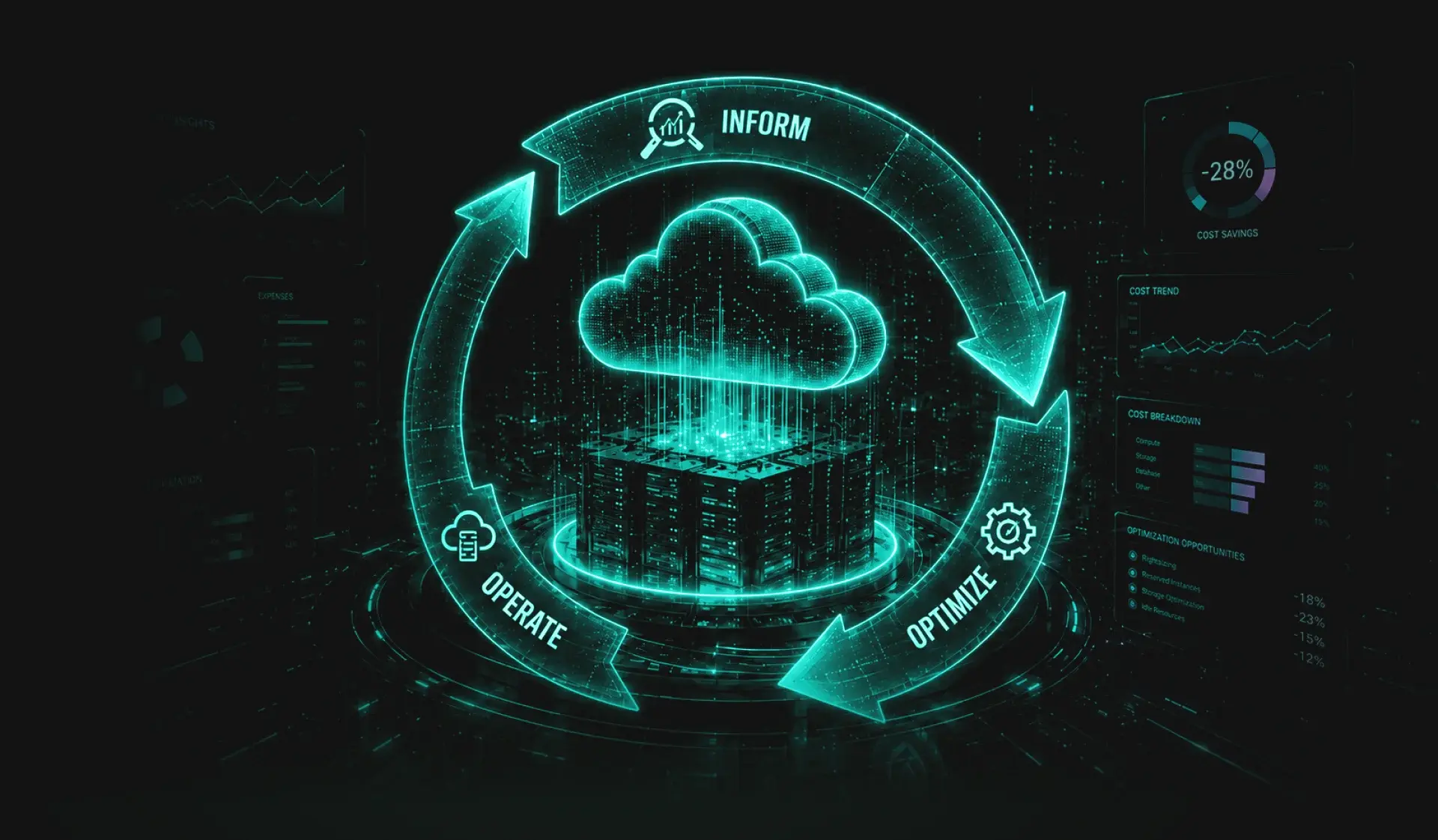
The FinOps cycle is:

In the Inform phase, teams get visibility into what the costs are for different services, ownership of every asset, customers/products driving the costs, and budget leakages. In the Optimize phase, teams make technical optimizations like rightsizing, autoscaling, reserved instances/ spot instances, Kubernetes optimization, storage optimization, pruning the unneeded resources, and making good architectural choices. In the Operate phase, cost management gets woven into daily processes – budgets, quotas, alerts, policies, validations, and cost reviews become an integral part of DevOps practices. That is where FinOps stands out from classical Cost Optimization. It is not about reducing the cloud bill once and forever. It is about building a cloud budgeting framework.
Why Engineering Plays a Critical Role
In today's cloud ecosystem, most decisions that contribute to cloud costs are actually taken within engineering flows. The software engineer defines the feature environment. The DevOps team sets up the Kubernetes cluster. The platform team builds the CI/CD flow. And the architect picks the managed service. Each of these decisions influences the final cost. This implies that the role of engineering is not limited to performance, reliability, and security anymore. The cost of architecture has turned into an engineering metric, similar to latency, scalability, and availability. In practice, this means:
- automated budget limits in CI/CD;
- required tags and owners for cloud resources;
- cost checks for infrastructure as code;
- alerts when budget thresholds are exceeded;
- automatic shutdown of temporary environments;
- regular reviews of overprovisioned resources;
- dashboards that are useful for both finance and engineering teams.
When these controls are built into the delivery process, optimization is no longer a manual campaign. It becomes part of platform engineering.
Accountability Matters More Than One-Time Savings
FinOps only works when teams understand the cost of their decisions and take responsibility for them. This does not mean engineers should focus only on cutting costs. The goal of FinOps is not to always choose the cheapest option. The goal is to make informed decisions: where cost is justified by business value, and where infrastructure is consuming budget without creating a measurable impact. Other times, however, the correct choice would be to invest more money, especially if doing so increases reliability, speeds up delivery, or helps in scaling products. However, such choices have to be deliberate and visible, with an impact on business results. That is because mature FinOps goes beyond merely using technology.
Conclusion
An initial cleanup of the infrastructure will save on cloud expenses. However, this will not prevent the cost escalation of the business. Cost Optimization asks: What can we reduce right now?FinOps asks: How do we keep cost management a constant element of engineering, operations, and decision-making? In the case of engineers, this implies the transition from the practice of reacting to cost optimization needs to the practice of managing costs through automation of budget restrictions in CI/CD, visualization per team and per product, cost-oriented architecture design, and accountability for all cloud assets. The cloud offers businesses agility and flexibility. FinOps provides agility with proper financial governance.

 Elizaveta Sokolova