




Skip to content

FinOps: Turn Cloud Costs into a Strategic Advantage

Gain visibility, predictability, and control over your cloud investments.

Why FinOps Matter?

Why FinOps Matter?

What Is FinOps?

FinOps, or Cloud Financial Operations, is an operational strategy and culture that combines engineering, finance, and product teams in order to work together to control cloud spending through data.

FinOps transforms cloud cost management from a purely technical effort into one focused on creating business value. In this way, finance is ingrained into the development process itself. Just like with performance, availability, and security, financial measures take on equal importance when assessing the architectural integrity of an application. Essentially, FinOps helps you make sound decisions about the ROI of each of your components.


The Cloud Cost Problem Nobody Talks About

Migration to the cloud environment radically alters the business financial model by transferring costs from CapEx to OpEx. However, in such a new world, the speed at which innovations are adopted frequently surpasses financial oversight capabilities.

While engineers today can build an entire cloud infrastructure with one click, finance cannot effectively oversee the process as it happens. The outcome of this situation is the emergence of a visibility problem: the actual financial impact of engineering activities becomes visible only after the monthly cloud billing statement comes into view at the end of the month.


The Hidden Cost of Cloud Success

The problem of uncontrolled costs rarely arises during the initial startup phase; it is typically a side effect of success and rapid organizational scaling.

As a product grows, the number of autonomous product teams increases, the architecture becomes more complex, and the number of microservices multiplies. In an environment heavily focused on time-to-market, infrastructure efficiency often takes a back seat. Consequently, successful companies face a loss of transparency: it becomes impossible to pinpoint exactly which product, feature, or team is driving a specific portion of the cloud invoice. Scaling without control ultimately transforms infrastructure into a source of hidden losses.

Why Traditional Cost Optimization Fails?

Most companies attempt to solve the overspending problem through periodic, one-off optimization projects. These measures fail to deliver long-term results for two reasons:

 Temporary effect: 

A one-time cleanup of unused resources (orphaned disks, inactive instances) reduces the bill for the current month but does not alter underlying processes. Within 2–3 quarters, costs return to their previous levels due to a lack of systemic constraints.


 Conflict of priorities: 

The traditional approach relies on top-down directives to "cut the budget," which engineers perceive as a threat to system stability and development velocity.


In contrast to one-off cost-cutting, systematic cost management integrates financial constraints into daily development workflows (CI/CD, architectural design), eliminating the very possibility of uncontrolled spending.


FinOps Is Not About Saving Money

The primary goal of FinOps is not simply budget cutting, but maximizing the business value of every dollar spent.

An increase in cloud spend is not inherently problematic if it correlates directly with revenue growth, an expanding active user base, or higher transaction volumes. FinOps provides businesses with transparent unit economics. This enables organizations to understand the true cost of serving an individual customer or running a specific service, transforming cloud expenditures from an unpredictable expense line item into a manageable driver of company growth.


How FinOps works?


How FinOps works?

The Three Pillars of Modern FinOps

Visibility:

Ensuring accurate cost allocation across teams, products, and business units in near-real-time. Every spent resource unit must have a clear owner.

Accountability:

Empowering engineering teams with the authority and responsibility to manage their own cloud spend. Development teams see the financial consequences of their architectural decisions and manage their budgets autonomously.

Optimization:

A continuous process of increasing resource efficiency: optimizing access permissions, selecting the correct instance types (Right-sizing), automating the shutdown of development environments during non-working hours, and leveraging cloud provider loyalty/commitment programs.

The Three Pillars of Modern FinOps

finops_cycle_transparent

Inform

The first step is ensuring transparency. At this stage, resource tagging is configured, costs are allocated by business context, and detailed dashboards are created for both engineers and management. The goal is to obtain accurate data for decision-making.

Optimize

Based on the collected data, measures are taken to improve efficiency. This includes optimizing instance sizes (Right-sizing), removing unused capacity, and applying financial instruments, such as purchasing commitments (Reserved Instances, Savings Plans) to secure long-term discounts from cloud providers.

Operate

Integrating FinOps into daily business processes. Automated alerts for cost anomalies are established, budget governance policies are implemented, and team KPIs are tied to resource efficiency. The process becomes continuous. 


 FinOps Maturity Model 

Crawl (Basic Level)

Allocation of basic costs. Implementation of basic rules for tagging of resources. Businesses have a holistic understanding of their spend, but react to deviations in retrospect. The level of forecast accuracy is low.

Walk (Competent Level)

80% of spending is allocated by the product/functional teams. Development teams perform regular analysis of their expenses. Automated notifications are set up. Tools for capacity management and resource reservation are used.

Run (Expert Level)

A high level of automation in processes. Direct integration of financial KPIs in development pipelines. Real-time optimization of costs is achieved. Budgeting planning is almost accurate.

Scale (Strategic Level)

A full embedding of FinOps practice into a corporate strategy. Costs of clouds services become part of unit economics of a company and influence product pricing and margin estimation.

Business value

Business value

Key Benefits of FinOps

Advantage

Business Outcome

Complete Transparency

Precise understanding of the cost of ownership for each product and service.

Forecasting Accuracy

Reduction of IT budget planning variance to < 5%.

Sustainable Scaling

Infrastructure growth is proportional to business revenue growth.

Increased ROI

Reallocating saved resources to the creation of new business features.


What Successful Organizations Measure


1. Forecast Accuracy

The percentage of variance between actual costs and the planned budget (target: less than 5%).


2. Cost per Customer / Unit

Infrastructure cost per active user or transaction. Enables assessment of architectural scalability.


3. Cost per Product / Feature

The exact cost of maintaining a specific feature or service of the company.


4. Resource Efficiency

The utilization rate of provisioned capacity (CPU, memory, storage). Target: eliminating idle resources.


5.  Business Value Metrics

The ratio of the company's profit growth rate to its cloud cost growth rate. 

What Sets Us Apart


What Sets Us Apart

Customer Journey

Discovery

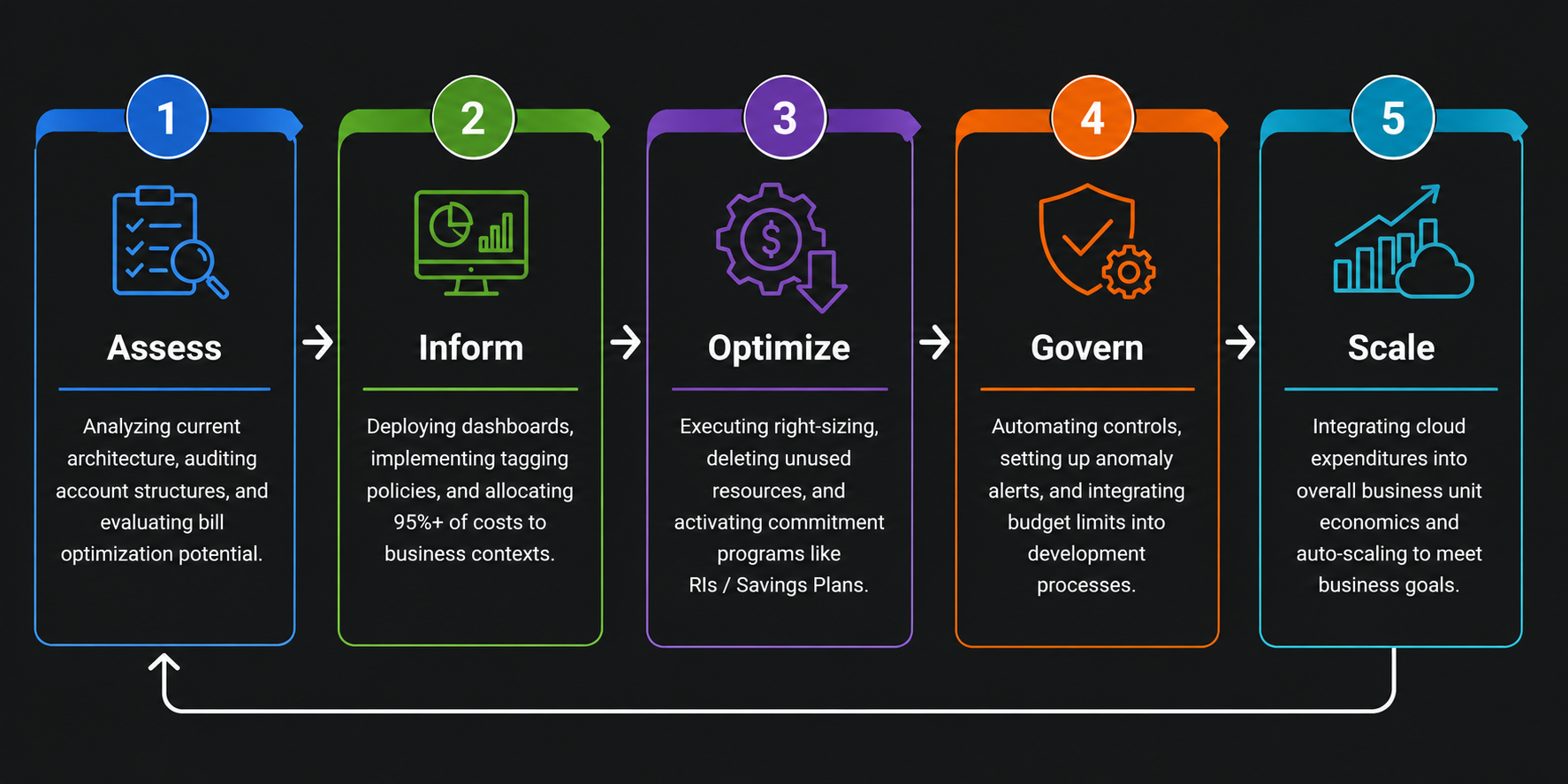
Perform initial assessment of the infrastructure and collect initial data on organization’s existing spending.

Assessment

Determine savings opportunities, find anomalies, and produce first report on inefficient resource usage.

Visibility

Implement monitoring solutions, structure accounts, and implement consistent tagging approach.

Optimization

Take action to deliver quick wins and optimize resources configuration for long term savings.

Governance

Create cost control strategies together with your team and set up automated alerts.

Continuous Improvement

Start iterative process to adjust infrastructure according to changing needs of your business.

Our 5-Stage Cloud Cost Governance Roadmap

f9c1f5ce-9ef0-48c1-8283-c0f02f84e15a

Supported Platforms

Amazon-Web-Services-AWS-Logo
Microsoft_Azure-Logo.wine
1684933804953

AWS FinOps

The specifics of the AWS ecosystem require a deep understanding of its pricing mechanisms. We configure the efficient use of AWS Savings Plans and Reserved Instances (RIs), minimizing costs for steady-state workloads.

Our experts optimize configurations in accordance with the AWS Well-Architected Framework, organize data storage into cost-effective Amazon S3 storage classes using Lifecycle Policies, and implement auto-scaling to handle peak loads without overpaying.

Azure FinOps 

Cost management in Microsoft Azure is built around subscription structures and Management Group hierarchies. We help properly configure Azure Hybrid Benefit, enabling you to use existing Windows Server and SQL Server licenses in the cloud for substantial savings.

Leveraging Azure Advisor and configuring Azure Reservations, we eliminate over-provisioned virtual machine configurations and optimize costs for databases and PaaS solutions.

Google Cloud FinOps

The Google Cloud Platform (GCP) environment features unique optimization tools, such as Sustained Use Discounts (SUDs) and Committed Use Discounts (CUDs). We design the architecture to maximize automatic discounts for stable consumption.

By exporting detailed billing logs to BigQuery and building dashboards in Looker Studio, we provide transparent cost monitoring for containerization in Google Kubernetes Engine (GKE) and serverless computing.

Multi-Cloud FinOps

For organizations leveraging the infrastructure of multiple providers simultaneously, having a consolidated data source is critical.
We build a unified cost management model that normalizes disparate metrics across AWS, Azure, and GCP.

This allows company leadership to view consolidated financial reporting in a single pane of glass, promptly compare the efficiency of different cloud platforms, and centrally manage IT department budgets.

Challenges We Solve

Lack of Cost Transparency

Eliminating scenarios where the origin of 30% or more of the monthly bill remains unknown.

Uncontrolled Bill Growth

Halting unpredictable infrastructure cost increases that outpace business metric growth.

Lack of Accountability

Shifting organizational culture from a "costs are the CFO's problem" mindset to personal responsibility among teams for the cost of the solutions they build.

Forecasting Difficulties

Eliminating discrepancies between planned budgets and actual invoices, thereby mitigating financial risks.

Multi-Cloud Complexity

Consolidating cost data from diverse cloud environments into a unified analytical model.


Industries We Serve

SaaS

Maximizing efficiency in infrastructure cost structure, enabling the business model to retain profitable margins amid rapid expansion in user base.

Finance

Achieving stringent adherence to security standards while at the same time cutting costs associated with creating duplicate analysis systems.

Healthcare

Keeping costs associated with storing huge amounts of protected health information at a minimum without violating any regulatory guidelines.

Retail/E-Commerce

Scaling out the infrastructure in line with peak sales seasons (promotions, flash sales) and immediately scaling it back.

Manufacturing

Minimizing costs involved in analyzing IoT-generated data and supporting predictive analytics infrastructure.

Why Choose Us

Deep Engineering Expertise:

We don't approach FinOps as theorists or accountants. Our background in DevOps, automation platforms, and systems architecture allows us to speak the same language as engineers and implement changes directly at the code and configuration level.

Business-Driven Approach:

We never compromise on performance or system stability for the sake of cost-cutting. Every solution we propose is evaluated based on its impact on key business metrics and development velocity.

Focus on Long-Term Results: 

We don't just clean up infrastructure; we hand over sustainable processes, train your teams, and implement automation that prevents cloud cost chaos from returning.

Our Technology Stack

T4itech integrates seamlessly into your existing infrastructure, thanks to our support for a vast array of tools and technologies. Our solutions are designed to fit your unique environment, ensuring smooth adoption and maximum compatibility with your current systems.
.

CI/CD

jenkins  Jenkins
gitlab  GitLab CI
azure devops  Azure DevOps
TeamCity  TeamCity

Containers

docker  Docker
kubernetes  Kubernetes
amazon ecs  ECS/EKS
azure aks  AKS

Automation & IaC

terraform  Terraform
ansible  Ansible
aws cloudformation  CloudFormation
chef  Chef
puppet  Puppet

Monitoring

prometheus  Prometheus
grafana  Grafana
elastic  ELK Stack
datadog  Datadog
New relic  New Relic
.

Cloud Platforms

aws  AWS
azure  Azure
google cloud platform  Google Cloud
hybrid-cloud-services-svgrepo-com 1  Hybrid/Multi-Cloud


Collaboration

github  GitHub
gitlab  GitLab
bitbucket  Bitbucket
slack  Slack
jira  Jira

Security

sonarqube  SonarQube
checkmarx  Checkmarx
snyk  Snyk

Conversation

teams  Teams
telegram  Telegram
discord  Discord
whatsapp  WhatsApp

End-to-End FinOps Architecture

End-to-End FinOps Architecture

Scalable FinOps Solutions by Growth Stage

Startups & Small Businesses

Targeted Audience: Young companies wishing to establish foundational infrastructures.

What is Included: Regular audit of the company’s foundations, detection of any anomalies related to costs and advice on resource optimization through the shutting down of dormant resources.

Scale-ups & Quickly Growing Businesses

Targeted Audience: Those that have been growing and have scaled up their product offerings and infrastructures.

What is Included: Continuous monitoring of infrastructures, application of tagging policy throughout the entire organization, effective management of saving plans and reservation instances along with monthly evaluation with a course of action outlined.

Enterprise


Targeted Audience: Large organizations managing either multi-cloud or hybrid infrastructures.

What is Included: Multi-cloud billing, automation governance with anomaly detection, financial metric integration into the CI/CD pipeline, FinOps Culture Workshops, and Advisory Services.

Core Capabilities

Evaluation & Exploration: 

An audit of the existing cloud management process to uncover any potential overspending as well as evaluation of the maturity of IT infrastructure.

Visibility & Allocations:

Tagging policies and cost allocation practices for greater than 95%+ of billing visibility.

Cost Optimization: 

A detailed technical review and analysis of configurations and resource optimization strategies without impacting the system’s performance.

Predictive Modeling & Forecasting:

Construction of cost forecasts from historical data and product roadmaps.

Governance & Operating Model:

Corporate policy creation and automated controls, as well as establishment of an internal FinOps Center of Excellence (CoE).


Frequently Asked Questions

Frequently Asked Questions

Have Question? We are here to help

Is FinOps good for SMBs?
FinOps becomes absolutely necessary when your monthly cloud spending starts to affect your business margins or become a significant part of your overhead costs.
What is the distinction between FinOps and classic Cost Optimization?
Cost Optimization usually refers to an occasional technical activity that helps reduce expenses. FinOps, on the other hand, is an ongoing process of culture change and workflow adjustment that introduces sustainable efficiency controls.
How much time does the first Assessment require?
Usually, this step takes about 2 to 4 weeks, depending on the size of your infrastructure and how many cloud vendors you are using.
Is FinOps needed for companies using just one cloud provider?
Yes. Problems like unclear billing, over-engineering infrastructure, and lack of financial responsibility among engineering departments are typical for any cloud infrastructure, no matter which vendor you have chosen.
What impact does FinOps have on development velocity (Time to Market)?
If done right, FinOps speeds up development rather than slowing it down. Through automation of routine governance and increased budget visibility, engineering organizations can receive rapid approvals to scale out their resource needs.
How would you measure ROI from implementing FinOps?

ROI is measured relative to your savings in infrastructure costs as compared to your previous spending trends, with a constant level of system performance maintained.

finops-roi-formula-final-transparent-white-1
 

Who shall be included in the internal FinOps team?

Normally, there exists an obvious cross-functional team (FinOps CoE) consisting of representatives of some departments, such as engineering department (holders of DevOps or Lead Architect position), finance department (financial analysts, or even CFOs) and product management (product owners).


What does "right-sizing" imply?

This concept means that we conduct the analysis of hardware usage (CPU/RAM) and then configure our virtual machines and databases based on our findings.

What are the benefits of FinOps when it comes to unexpected costs?

The Govern phase includes installing of automatic anomaly detection tools. It constantly analyses the pattern of spending and notifies engineers about any deviation, thus stopping us from overpaying for services.

How is containerization handled within FinOps framework?

There are special tools that allow us to track the costs of our cloud not on the cluster level, but on pod/namespace/microservice/team level.

Is there an obligation to have an in-house FinOps specialist?

Using FinOps as a Service in the initial adoption stage proves to be extremely efficient. By doing so, you get the benefit of adopting proven processes without spending much time or money in the process and avoiding design-related mistakes.

How do you ensure data security in the course of the cost audit?

To complete the analysis, we need Read-Only access only to your billing data and metrics related to resource consumption (e.g., via CloudWatch or Azure Monitor). Neither your sensitive information nor your clients' will be accessed in any way. All cost assessments are fully protected by an NDA and other legal procedures.

What percentage of cloud spending can be saved using FinOps?

Based on the maturity level of your workflow processes, FinOps implementation helps reduce unnecessary cloud expenses up to 15% to 40%. The savings will not affect your system performance at all.

Schedule a Personal Demonstration